
Matagorda Parole and Probation Compared
Parole and probation both permit a person to live outside a secure facility while following rules. Their legal source is not the same. Matagorda County probation begins with a local court order and is managed by the Matagorda County Community Supervision and Corrections Department, or CSCD. State parole and mandatory supervision follow a TDCJ prison or state-jail term. Those cases are managed by the TDCJ Parole Division.
That split controls the search. Someone who left Matagorda County Jail on bond may have neither status. A person transferred from the jail to TDCJ has not yet been released to the community. Someone sentenced to probation can be supervised locally without ever appearing in TDCJ custody. Match the name, date of birth, case, and official ID where possible.
| Point | Parole or mandatory supervision | Probation or community supervision |
|---|---|---|
| Legal source | Release from TDCJ under state law and a Board decision or mandatory-supervision process | Sentence or order from the court handling the local case |
| Supervising body | TDCJ Parole Division | Matagorda County CSCD |
| Best public starting record | TDCJ offender search or TDCJ IVSS | County or district court case record |
| Local office | Angleton District Parole Office | Matagorda County Adult Probation in Bay City |
| End point | Discharge, revocation, or other formal status change | Completion, early termination, revocation, or another court order |
- Parole
- Conditional release from a TDCJ term before the full sentence ends.
- Mandatory supervision
- A form of supervised TDCJ release governed by eligibility rules and, in many cases, Board review.
- Probation
- The common term for court-ordered community supervision.
- Discharge
- The formal end of a sentence or supervision term, not merely release from a jail.
- Absconder
- A person alleged to have stopped reporting or left supervision without permission.
Verify Matagorda Post-Release Supervision
Start with the custody history, not a guess based on a roster. The TDCJ offender-information gateway applies to state prisoners, state-jail inmates, and related TDCJ histories. TDCJ has no jurisdiction over county jails. For a Matagorda court sentence, use the county Judicial Records path and identify whether the County Clerk or District Clerk maintains the case.
A name alone can produce a false match. The TDCJ-CID number, SID, date of birth, county of conviction, and cause number can separate people with similar names. A projected release date or favorable parole vote is not an actual release record. Seek a current supervision status or a post-event release date, then confirm the office assignment.
- Identify whether the person served a TDCJ term, received a Matagorda County court sentence, or merely left county jail custody.
- For state parole, search the TDCJ online inmate search and review current status, release data, and parole information.
- For parole-review information, call the BPP Offender Status Line at 844-512-0461 with the name, TDCJ-CID number, and date of birth.
- For probation, obtain the signed judgment or supervision order through Matagorda Judicial Records and the correct clerk.
- Use the official office directories to confirm whether Angleton DPO or Matagorda County CSCD handles procedural questions.
- Verify any claimed completion through the discharge record or later court order.
For a full county booking-out and court-record path, use the Matagorda County released-inmate search. It separates the physical jail exit from the court authority and any later supervision.
Note: A scheduled release field can change while TDCJ audits the certificate, programs, release plan, and legal holds.
Matagorda Parole Office Assignment
TDCJ’s official county cross-reference assigns people supervised for Matagorda County to the Angleton District Parole Office in Region III. The office can address reporting logistics and office assignment. It should not be expected to disclose protected case details to any caller.
The TDCJ county-to-office map shows that local assignment. The successful official-source capture below documents the Matagorda-to-Angleton mapping.
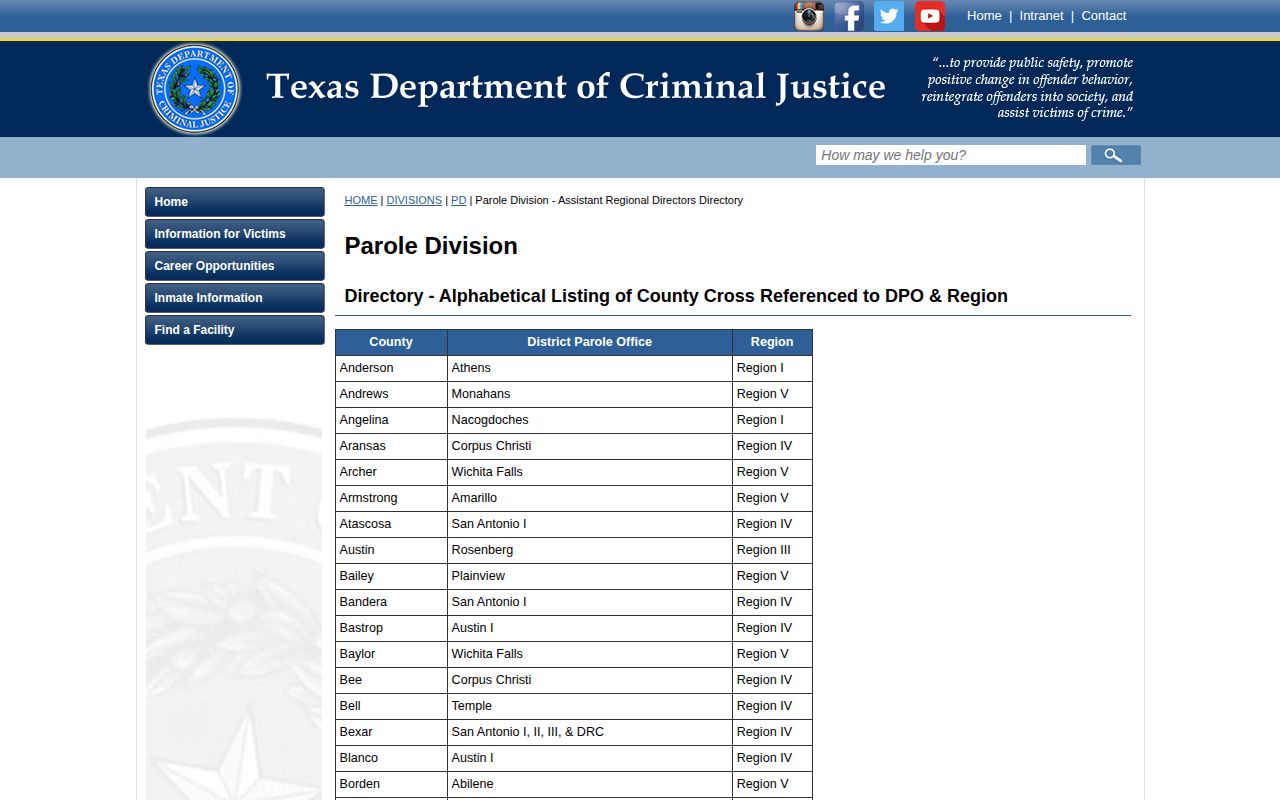
This map matters because the parole office is outside Matagorda County, while county probation is based in Bay City.
Angleton District Parole Office1208 North Velasco
Angleton, TX 77515
Phone: 979-849-2461
Fax: 979-849-9279
Matagorda Probation Units and Hours
Matagorda County CSCD publishes more than a general probation number. Its Adult Probation page identifies felony and misdemeanor work, specialized high-risk supervision, substance-abuse functions, SAFPF, ICOTS, pretrial diversion, and support roles. SAFPF refers to a state substance-abuse felony punishment facility program. ICOTS is the interstate compact tracking system used when supervision crosses state lines.
Those units can help route a procedural question, but the office page does not offer a public person-name probation lookup. The signed court record remains the sound way to establish that a community-supervision sentence exists. Contact the office after the court and cause number are known.
The official Matagorda County Adult Probation page provides the local units, hours, and contact information shown in this source image.
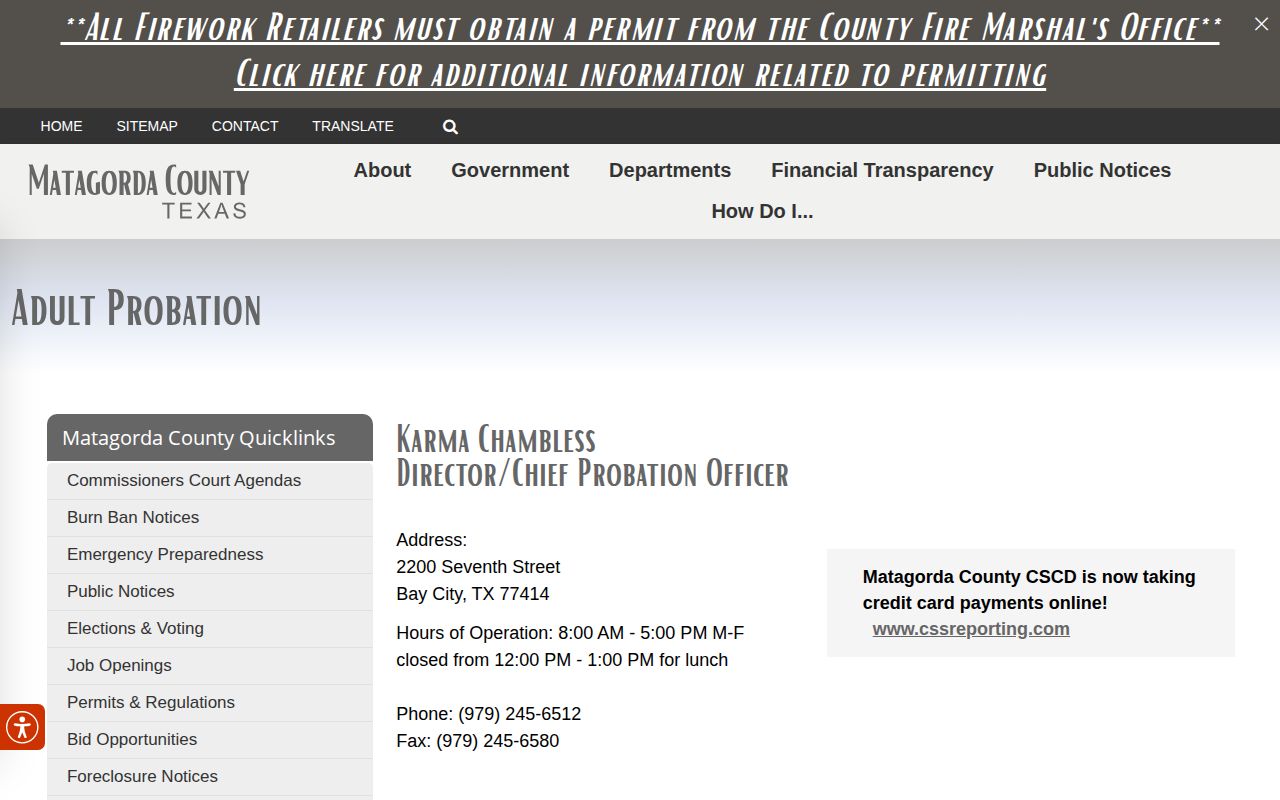
The published noon closure is a useful detail when planning an in-person or phone inquiry.
Matagorda County CSCD Adult Probation2200 Seventh Street
Bay City, TX 77414
Phone: 979-245-6512
Fax: 979-245-6580
Monday through Friday, 8:00 a.m. to 5:00 p.m.
Closed noon to 1:00 p.m.
Note: Pretrial diversion is not the same as a final probation sentence; confirm the actual court disposition before describing the status.
Matagorda Supervision Warrants and Violations
Conditions vary by case. They may require reporting, approved travel, programs, payments, or other conduct set by the Board or court. A breach allegation does not itself show the final result. TDCJ explains that a parole warrant may follow a new charge or indictment, absconding, or an alleged supervision violation. The warrant remains active until it is withdrawn or an arrest occurs.
No official statewide public parolee roster or separate parole-absconder list was found. Do not substitute an unsupported county wanted list. Use TDCJ status and the responsible agency. A formal revocation hearing is different from ordinary parole review. After a revocation case, the Board may continue supervision, change conditions, choose another placement, allow discharge when appropriate, or revoke release.
County probation violations return to the court with jurisdiction over the case. The docket and signed order show whether the court continued, modified, terminated, or revoked community supervision. An arrest on a warrant shows custody activity, not the final supervision outcome.
Matagorda Supervision Status Alerts
Notification systems can add timely context. County booking and court events use Texas IVSS-Counties when the county participates. TDCJ prison, parole, and mandatory-supervision events use the separate TDCJ IVSS. These are not interchangeable databases.
A notice can prompt a call or records check. It is not the official discharge record. IVSS also warns that its information may not be fully current or complete. A person who has left custody may disappear from a search, and a registration can remain active if that person later returns.
Note: Confirm Matagorda participation in the live county portal before relying on a county booking or court-event subscription.
Matagorda Release Documents for ID
Post-release papers may help with a Texas identification-card application. The Texas DPS identification requirements recognize a TDCJ inmate ID and a TDCJ parole or mandatory-release certificate as supporting identity documents. A federal inmate ID or federal parole or release certificate can also serve as supporting material.
These papers are not always enough by themselves. The standard identity, lawful-presence, Social Security, and Texas residency requirements still apply. Keep the original release or supervision certificate safe, check the DPS list before visiting, and gather the other required records. This is one practical reason to distinguish a true TDCJ release certificate from a Matagorda County booking-out sheet.
When Matagorda Supervision Ends
Release from a cell and discharge from supervision occur at different points. Parole may end through formal discharge, reach another authorized outcome, or be revoked. Probation may end when the term is completed, when a court grants early termination, or through a later court action. The expected end date is not enough if a violation, warrant, or new order intervened.
For parole, request or verify the final TDCJ status and discharge information. For probation, use the Matagorda court docket and signed termination or completion order. Government Code Chapter 508 governs key parts of Texas parole and mandatory supervision, but it does not turn a roster absence into proof. The final record from the agency or court is the sound conclusion.
A court sentence, jail release, parole start, and supervision discharge can each have a different date. Preserve those labels when taking notes. If a Matagorda County court granted probation, the judgment states the term and conditions, while a later docket entry may show an amendment or early end. If TDCJ released a person on parole, the release certificate and current offender status address state supervision. Neither should be replaced with the date the person vanished from a web list.
Records can also answer whether custody resumed. A county booking after an alleged violation may identify the arrest and hold, but it does not show the final Board or court decision. Check for a revocation result, continuation order, changed condition, or discharge. This keeps a short custody event from being mistaken for the end of Matagorda County parole or probation.