
Matagorda County Release Date Stages
Four dates can appear in a Texas corrections case, and each answers a different question. A parole eligibility date is the first point when the Texas Board of Pardons and Paroles may consider release. It is not a promise. A projected release date is a TDCJ calculation based on the offense date, sentence, mandatory-supervision law, and time accounting. Depending on the case, that field may point to possible mandatory supervision or to discharge at the end of the sentence.
A scheduled release date and location may appear after favorable action and a release-certificate audit. It is more concrete than an eligibility date, yet it may still change. The actual release or discharge date is recorded after the custody event and is the best confirmation that the event occurred. For a Matagorda County Jail booking, the booking-out record supplies the physical exit time. The court record explains the legal authority. A transfer entry means county custody ended, but custody continued elsewhere.
Search Matagorda County Release Dates
Start with the holding system, not the charge name. TDCJ states that it has no jurisdiction over county jails. Someone who bonded out of Matagorda County Jail without entering state custody may never appear in the TDCJ offender database. In contrast, a person sent to a state prison or state jail must be checked through TDCJ, even if the criminal case began in Matagorda County.
- Check the Matagorda County Public Records gateway and choose Jail Records for a county booking.
- For a state sentence, search the TDCJ online inmate search by name and, when known, TDCJ number, SID, or date of birth.
- Open the offender detail and distinguish the projected field from any scheduled release date and location.
- If the web result is unavailable, use the TDCJ offender-information email route and provide enough identifiers to match the right person.
- For a county sentence, ask the jail for its booking-out record and the court for the judgment, signed credit, or release order.
The broader Matagorda County released-inmate search explains how to trace a person across county, state, federal, and immigration systems. Do not infer release from the loss of a roster entry. Ask whether the exit was a bond release, sentence completion, TDCJ transfer, another warrant, federal pickup, or immigration custody.
If TDCJ email assistance is needed, provide the full name and TDCJ number. When the number is unknown, include date of birth or approximate age and the county of conviction. Ask for the incarceration history, current status, projected release date, actual release or discharge date if available, and supervision status. This targeted, no-charge information route is different from seeking an entire correctional file through a broad public-information request.
TDCJ Matagorda Release Date Fields
The TDCJ offender-information gateway describes its search as providing location, offenses, and a projected release date. After favorable parole action, the Board instructs users to look for “Scheduled Release date” and “Scheduled Release location.” Those fields remain subject to the release-certificate audit and can change without notice. A favorable vote alone does not show that the person has left custody.
| Field | What it establishes | What it does not establish |
|---|---|---|
| Parole eligibility date | Earliest point for Board consideration under the governing law | Approval or a release appointment |
| Projected release date | TDCJ's current time-accounting calculation | A completed release |
| Scheduled date/location | A planned event after favorable action and audit work | An unchangeable date |
| Actual release/discharge | The post-event status and date recorded by the agency | The county court's full legal history |
The official TDCJ definitions and email fallback show how projected dates depend on mandatory-supervision eligibility.
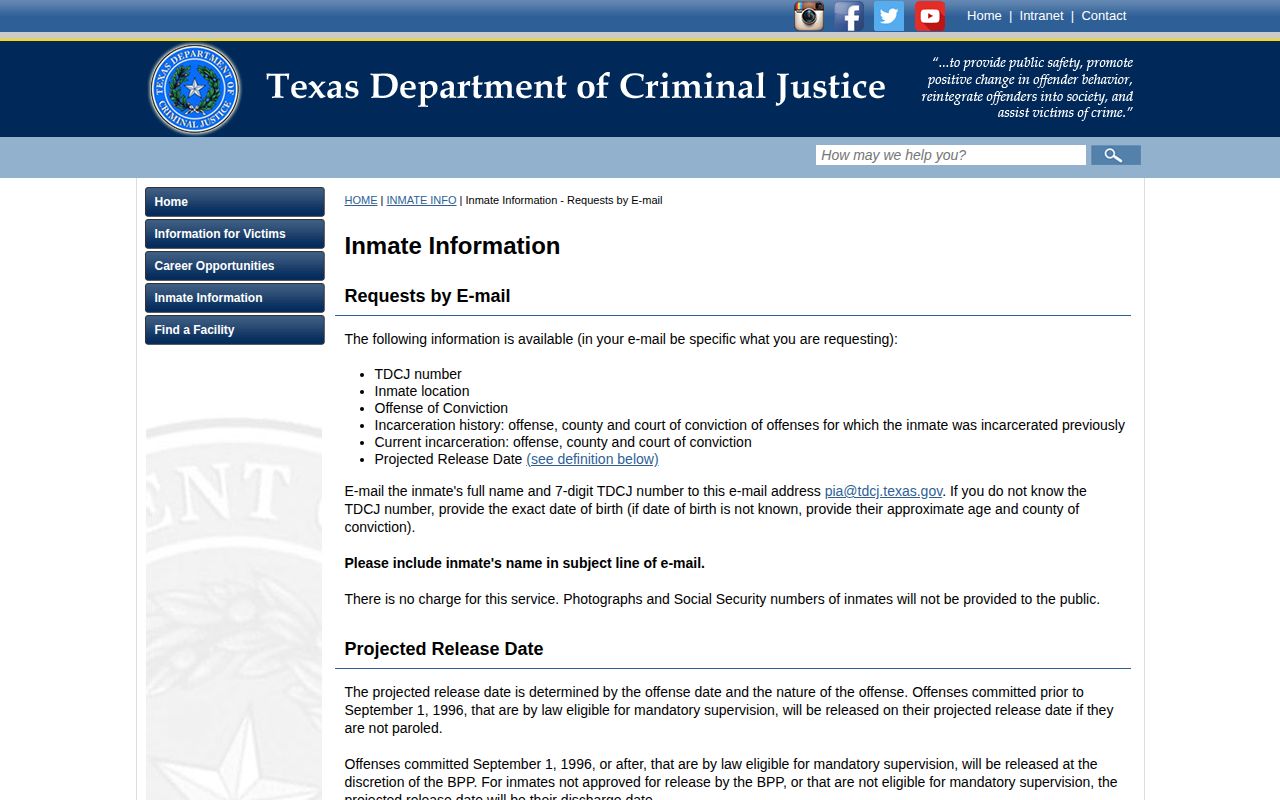
This official screen is useful when a public offender result is missing or when the meaning of a projected field needs direct agency confirmation.
Texas Release Date Rules
Texas has no universal rule that every TDCJ inmate must serve 85 percent of a sentence. A broad claim like that is not sound Texas guidance. The result depends on the offense, offense date, sentence, statutory category, time credit, and any deadly-weapon finding. The central parole-eligibility law is Government Code Chapter 508.
Under the general residual rule in Section 508.145(f), actual calendar time plus good-conduct time must equal one-fourth of the sentence or 15 years, whichever is less, before parole eligibility. For aggravated offenses in current Article 42A.054 and deadly-weapon categories addressed by Section 508.145(d), eligibility generally requires actual calendar time equal to one-half of the sentence or 30 years, whichever is less. Good time does not count toward that aggravated threshold. Other offenses and exclusions have their own rules.
The older term “3g offense” refers to a former statute. The more accurate current phrasing is former-3g/current Article 42A.054. Even a correct eligibility calculation does not compel parole. The Board may deny release, and other legal holds or release-plan requirements may remain. Never calculate a person's date from a charge label alone. The judgment, offense date, sentence, relevant findings, TDCJ calculation, and current Board status all matter.
A parole decision and a release date answer separate questions. Approval may carry conditions, required programs, or a later month and year. Staff must still finish release planning and certificate review. New disciplinary allegations, protests, or case facts can prompt reconsideration. A denial may set another review point or require the person to serve more time. In each case, the latest TDCJ detail is more useful than an old saved result, but only the post-event status confirms that the person left state custody.
Note: A parole eligibility date permits review; it does not set the Matagorda County inmate's actual release date.
Good Time Changes Release Dates
Government Code Section 498.003 states that good-conduct time applies to parole and mandatory-supervision eligibility under the listed laws. It does not otherwise shorten the sentence. Good time is a privilege, not a right. Statutory classes include different accrual rates, including 20 days per 30 days actually served for trusty status and Class I, 10 days per 30 for Class II, and none for Class III. Trusty status can receive added credit in qualifying cases.
Classification can change. Credit may be lost through disciplinary action, and questions about forfeiture or restoration affect a current projection. Mandatory supervision also has limits. Section 508.149 excludes listed offenses, while eligible cases after September 1, 1996 are subject to discretionary Board review. If mandatory supervision is denied or unavailable, the projected field may instead reflect the discharge date.
| Change | Possible effect | Best record to check |
|---|---|---|
| Disciplinary action | Credit class or accumulated credit may change | Current TDCJ time calculation |
| Parole action | Approval, denial, or later review alters the practical path | BPP result and TDCJ detail |
| Detainer or warrant | A planned exit may become transfer to another authority | Agency hold and receiving record |
| Court order | Sentence, credit, or legal authority may be revised | Signed judgment or order |
| Release audit | Scheduled date or location may move | Latest TDCJ scheduled fields |
Matagorda Jail Release Date Math
Do not apply TDCJ formulas to a Matagorda County Jail sentence. County release timing depends on the judgment, credit awarded by the court, local jail time accounting, bond or other release authority, unresolved holds, and the facility's processing. A person held before trial has no sentence-based projected date. Bond eligibility can create a possible path out, but the date remains unsettled until the bond is posted, all holds are resolved, and jail processing is complete.
Bay City Municipal Court publishes a time-served motion for a local citation disposition. That document can explain how the municipal matter was resolved. It does not prove the exact moment someone walked out of the jail, nor does it answer whether another agency took custody. Compare the municipal court action with the booking-out entry held by Matagorda County Jail.
- Time served
- A sentence or court credit treated as satisfied. The signed record controls.
- Detainer
- A request or legal basis for another authority to hold or receive the person.
- Discharge
- Completion of the sentence or correctional obligation shown by the responsible agency.
- Mandatory supervision
- A form of supervised state release governed by eligibility rules and, for many cases, Board review.
Older Matagorda Release Date Records
The county has not published a confirmed period for keeping released bookings visible in its Tyler jail portal. Online visibility and agency retention are not the same. Texas Local Schedule PS requires prisoner incarceration records, including booking-in/out, transfer, and release materials, to be retained for at least two years after release or transfer. Prisoner property inventories and receipts have the same minimum.
This distinction is useful after a Matagorda County roster entry vanishes. A failed portal search does not prove the record never existed. Submit a narrow written Public Information Act request for the booking-in/out sheet, release date and time, recorded release type, authority, and receiving agency if a transfer occurred. The state retention schedule supports that records-office fallback, but it does not promise that a document will remain online or override a lawful expunction order.
Matagorda County's written-request route can be used when the portal no longer supplies enough detail. Identify the full name, aliases, date of birth if known, approximate booking dates, arresting agency, and booking or SO number. Ask for an electronic copy of existing records rather than asking staff to calculate a date. A precise request helps staff distinguish the right booking and limits confusion between release to the community and transfer to another custodian.
The jail line is 979-241-3275. A call can clarify which office holds the record and whether staff recorded a transfer, but the County requires a written request under its Public Information Act process. Court records follow a different route. Felony and district matters generally belong with the District Clerk, while county criminal and misdemeanor matters generally belong with the County Clerk. The court action explains authority; the jail record establishes when physical processing ended.
For notice of a planned county event, use the current Texas IVSS-Counties system only if Matagorda participation is confirmed. For state prison or parole events, use the separate TDCJ IVSS. The Matagorda VINELink Release Check explains the current services and the legacy name. An alert is a prompt to verify the agency record, not the final proof.
Note: A transfer closes county custody but is not community release; always identify the receiving agency before treating the date as final.